
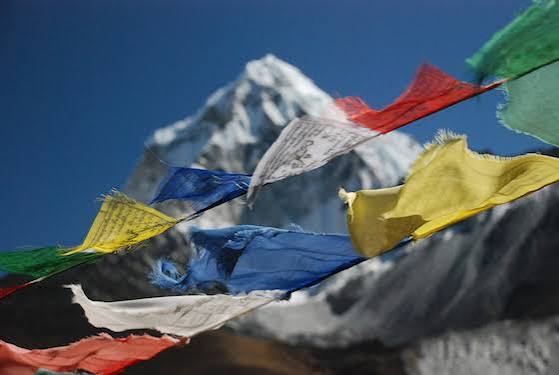
I’ve seen them in photographs of Nepal for years. Strung across mountain passes, hanging from rooftops, draped between trees, and fluttering in the wind against some of the most beautiful mountain scenery in the world.
Those colorful little flags.
I’ll admit, until recently, I hadn’t given much thought to what they actually meant. I knew they were called prayer flags, but that was about the extent of my knowledge.
And since I’m heading to Nepal, I figured it was probably time to learn a little more than that.
Because I don’t want to just photograph beautiful things while I’m there. I’d like to understand at least a little about what I’m looking at.
So, what are prayer flags?
The flags most people recognize in Himalayan photographs are associated with Tibetan Buddhist traditions. They’re traditionally printed with prayers, mantras, and meaningful symbols.
The idea is that when the wind moves the flags, it carries those prayers and good wishes outward into the world. They’re intended to spread blessings, compassion, peace, and well-being—not just for the person who hangs them, but for all living beings.
I like that idea. Something created with the intention of sending good wishes out into the world, without needing to know exactly who might receive them.
Prayer flags are often called lung ta, which translates to “wind horse.” The wind horse is a common image on the flags and represents good fortune and the movement of positive energy.
The five colors aren’t random
One of the first things I learned is that the traditional prayer flags come in five colors, and each color represents an element.
The traditional sequence is:
- Blue: Sky and space
- White: Air and wind
- Red: Fire
- Green: Water
- Yellow: Earth
Together, the colors represent the elements and their balance. They’re traditionally arranged in a particular order rather than randomly strung together.
I had always thought the colors were mostly there to make the flags beautiful. Turns out, there’s a lot more meaning behind them.
What’s actually printed on them?
If you look closely, prayer flags aren’t just blank pieces of colored fabric.
They can include sacred mantras, prayers, auspicious symbols, and images. One of the most recognizable designs features the wind horse carrying three jewels, which represent the Buddha, the Buddhist teachings, and the Buddhist community.
Other designs may include animals, deities, and different symbolic images.
The exact designs and prayers can vary. There’s more to them than one standard pattern, which makes me want to take a closer look when I see them in person.
Why are they hung outside?
This part makes a lot more sense now that I understand the purpose.
Prayer flags are hung where the wind can reach them—along mountain ridges, over passes, near temples, around homes, and in other open places.
The wind is an important part of the tradition. As it moves through the flags, the prayers and blessings are believed to spread outward.
And that brings me to something I hadn’t thought about before: the flags aren’t necessarily meant to stay bright and beautiful forever.
They’re supposed to weather and fade
This might be my favorite thing I’ve learned about them.
Prayer flags are exposed to the sun, wind, and weather. Over time, their colors fade and the fabric becomes worn.
Rather than treating that as damage, the fading is connected to the idea that the prayers have been carried outward by the wind. In some traditions, old flags are allowed to wear away naturally; others are respectfully taken down and burned.
New flags may be hung alongside older ones, too.
There’s something meaningful about that. They’re not really meant to be permanent decorations. Their purpose is in what they represent and what they send out into the world, not how long they stay looking new.
A little perspective before I go
One thing I want to remember as I learn about Nepal is that the country isn’t culturally or religiously one-size-fits-all.
Prayer flags are particularly associated with Tibetan Buddhist traditions and are visible in many Himalayan communities and places in Nepal. But Nepal is home to many different religions, ethnic groups, languages, and traditions. I don’t want to assume that one beautiful tradition represents everyone.
I also know that reading about something is not the same as understanding what it means to the people who practice it.
So when I see prayer flags in Nepal, I hope I’ll notice more than the colors. I’ll remember the prayers, the symbolism, the wind, and the intention behind them.
And maybe I’ll take a few photographs.
Okay, let’s be realistic. I’ll probably take a lot of photographs.
But at least now I’ll know a little more about what I’m photographing.
One small thing learned before the adventure even begins.





Leave a Reply